
Who Started Amanohashidate’s “Matanozoki”?
An Investigation
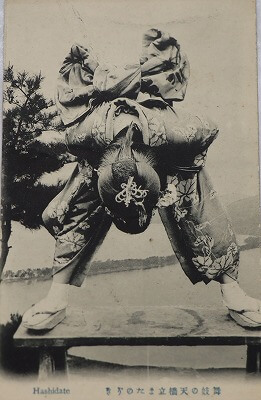
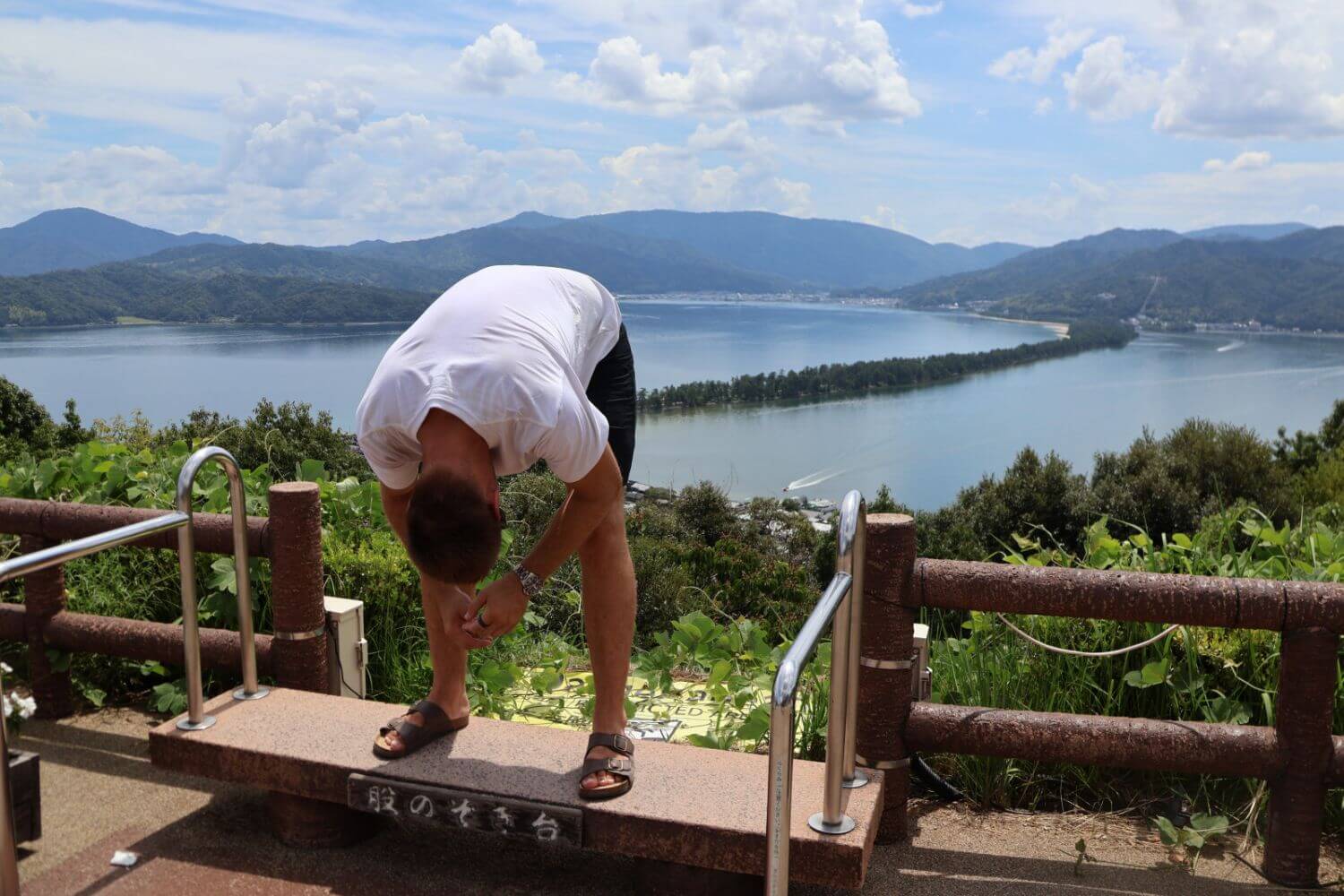
For all visitors to Miyazu City in Tango, there is a common sight. In front of Amanohashidate, one of the Three Views of Japan, a figure bends down and looks out over the sandbank through their legs. This is the “Matanozoki” (literally “peeking through the crotch”), a study of which completed by Ritsumeikan University recieved an Ig Nobel Prize in 2016. But when did this slightly embarrasing method of taking in the scenic view begin?
When you look at the scenery upside down, the sandbank of Amanohashidate appears as if a dragon is stretching towards the sky. Kasamatsu Park (Ogaki, Miyazu) is known for this superb view, and in the park stands a sign proclaiming it the “Birthplace of the Matanozoki“. The sign was put in place by the Kyoto Prefectural Government 13 years ago.
Let us begin by looking into the history of the Matanozoki.
I started by asking Takashi Azuma (62), chief of cultural treasure preservation at the Miyazu Board of Education, and was handed the volume “Invitation to ‘Amanohashidate'” (published by Hozokan). Within the volume, there was a section introducing the writings of scholars who travelled to Amanohashidate, and it contained the following text:
“Generally, visitors arriving at this place follow the custom of bending down and viewing the scenery through their crotch.”
This line was recorded by Tenzui Kubo, a scholar of Chinese literature, in 1896. I was told it was the oldest written record of the Matanozoki.
Tenzui was looking from Kasamatsu, midway up Mt. Nariai, to the north of Amanohashidate. Four years later, an observation deck would be built there, and in the Taisho era it would be fully equipped as a park.
Now we know the etymology, but how did it begin? Asking Takashi, he simply said “The origin? Nobody knows that, or it might be better to say there is no answer.”
Hearing that makes a reporter want to dig. Are there any other hints? I continued flipping through the volume from earlier here and there, until another line caught my attention:
“They told me ‘the Matanozoki was proposed by the Inn’s previous owner.'”
This line was recorded by the author Sohei Morita, a student of the famous Japanese author Soseki Natsume, in 1935. The section recorded what he heard from a hostess while staying in the high-end Inn “Araki Villa“.
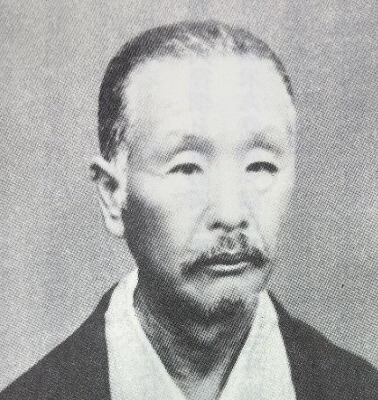
This is it! So, who is the “previous owner”?
At the time, the Araki Villa was said to be the best in the San’in region. It looked out over Amanohashidate, and was founded in 1887 by Kinbei Araki (1854 – 1920). From the time Sohei’s account was written, it is likely safe to assume that the previous owner was Kinbei.
Continuing to research Kinbei’s life, I was lucky to find the Araki, Miyazu Family Chronicles at the city library (published 1990). According to the chronicle, in addition to operating the Villa, Kinbei was deeply involved in early tourism development across Amanohashidate and the nearby Castle town, such as the rebuilding of Amanohashidate Shrine.
The book also mentioned the origin of the Matanozoki. At the time, it was called “Matagankyou” or “crotch spectacles”, and Mr. Ken, the grandson of Kinbei and compiler of the book, wrote that he heard from his uncle and parents that “Kinbei thought of the looking through the crotch as Matagankyou“, emphasizing that “The Matagankyou was definitely something that Kinbei conceived.”
I thought to ask Mr. Ken directly and immediately tried reaching out to the contact information listed in the book, but it was no use. Mr. Ken had unfortunately already passed away…
The originator was Kinbei. It seemed certain at this point, but I wanted confirmation from his descendants.
Travelling to the address listed in the family chronicles, I found the house was empty. Asking the neighbors, they were able to tell me where the family had moved to. Based on what they told me, I travelled to the approximate location, and after some searching found a house with the nameplate “Araki”.
Welcoming the suspicious and unexpected knock on their door was the great-granddaughter of Kinbei, Mine Araki.
“I don’t know anything about the family history. My cousin in Nagoya might, though.”
Mine called another great-grandchild, Hideko Tsuboi (78), and soon after I travelled to Nagoya to hear more.
Hideko apparently lived in the Araki Villa while they were in elementary school. “It was run as Araki Villa until the summer of 1958. After that, everything was sold to a maritime shipping company.” They spoke matter-of-factly about the villa, and became untalkative once the conversation turned to Kinbei. It seemed that the family had not spoken very much about him.
“So, it was Kinbei that thought of the Matanozoki?” I asked. Hideko answered immediately.
“I don’t know whether it was Kinbei that thought of it.”
As for why, they said “I never heard anything from Ken about Kinbei conceiving of it … Personally, I would like to say that it was Kinbei that thought of it, but… It is hard to imagine Kinbei looking through his crotch at the view, thinking ‘this is great’ and conceiving the Matanozoki.”
Needless to say, I returned to Miyazu in low spirits.
Even now 130 years later, the Matanozoki of Amanohashidate continues to be passed along to visitors. Was the originator of this custom Kinbei, or someone else? Did he have a collaborator? If anyone holds more information, please reach out.
Copyright © The Kyoto Shimbun
Translated by Kyotango City Tourism Association