2026.11.17|Town
Protected: Zuwaigani Season Begins, Momogani Restraint and the Value of Nature
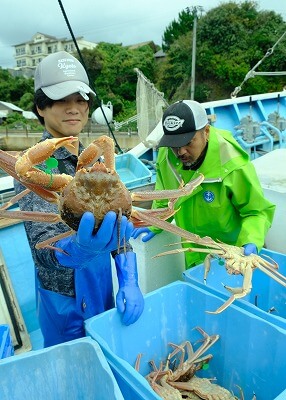
The first Zuwaigani to be landed for the 2026 season. The green tag attached distinguishes it as a Taizagani. (November 9th, Taiza Fishing Port, Tango-cho, Kyotango)
Looking at the beetle in front of his eyes, the boy’s breath was taken away. A carapace of vibrant lapis lazuli. Spots of azure blue and black extending up to the creature’s antenna. “How could such a beautiful color exist?”
This was a formative experience of Shin-ichi Fukuoka, researcher of molecular biology. Discovering the distinct blue and black spotted longhorn beetle (Rosalia batesi) in a reference book, he searched wild mountains for days to catch a glimpse of it. The surprise upon finally seeing the beetle sent him down the path of researching genetics and biology.
From invertebrates (including beetles) to mammals, creatures carry characteristic colors. These colors can be influenced by their stage of life or gender, vary depending on the season, and be used as a survival strategy. However, many of these distincive creatures living in the wild face overhunting and habitat reduction, with specialists strongly calling for measures to protect natural ecosystems.
This is true for Zuwaigani (snow crabs), caught in the Sea of Japan starting every November. The landing of “Peach” Momogani crabs, called such due to the peach colored undersides of their shells, has been voluntarially restricted by the fishing industry of Kyoto prefecture. These immature Zuwaigani have smaller pincers than their grown up counterparts. The restriction is apparently a measure to attempt to protect the natural resource, and the first of its kind in Japan.
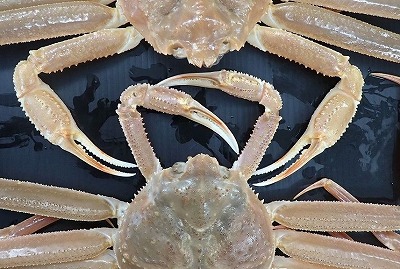
From this season, fishing is restricted for the Momogani (bottom). Compared to crabs who have completed their final molting (top), their pincers are small. (provided by the Kyoto Preectural Agriculture, Forestry and Fisheries Technology Center)
As this restriction begins, the western Sea of Japan is projected to see reduced catch volumes. Starting this season, fishers will catch only the fully grown crabs, stabalizing future supply. Peach crabs are enticing, but it is for the best that they don’t land on our tables.
Rather than a single catch, think of the Ocean’s cycle of life. Mr. Fukuoka conceptualizes the everlasting cycle of life as an altruistic history of different creatures cooperating and providing for each other. Living alongside nature, while complementing each others weaknesses. As the Autumn leaves begin to fall, the food becomes more vibrant. Enjoy the various colors, and appreciate the blessings of nature.
Copyright © The Kyoto Shimbun
Translated by Kyotango City Tourism Association
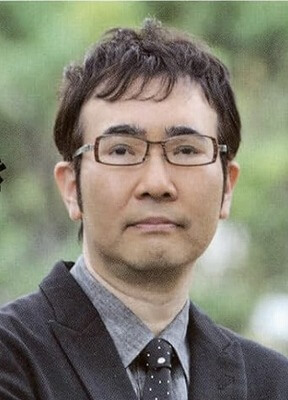
Shin-ichi Fukuoka, researcher of molecular biology (from his novel "Between Life and Non-Life", published by Kodansha)
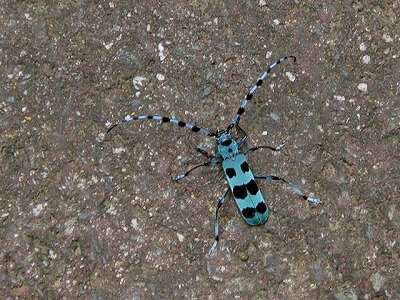
A longhorn beetle with blue and black spots.