2026.09.03|Town
Revived by Imperial Marriage
The Tango Chirimen Golden Age
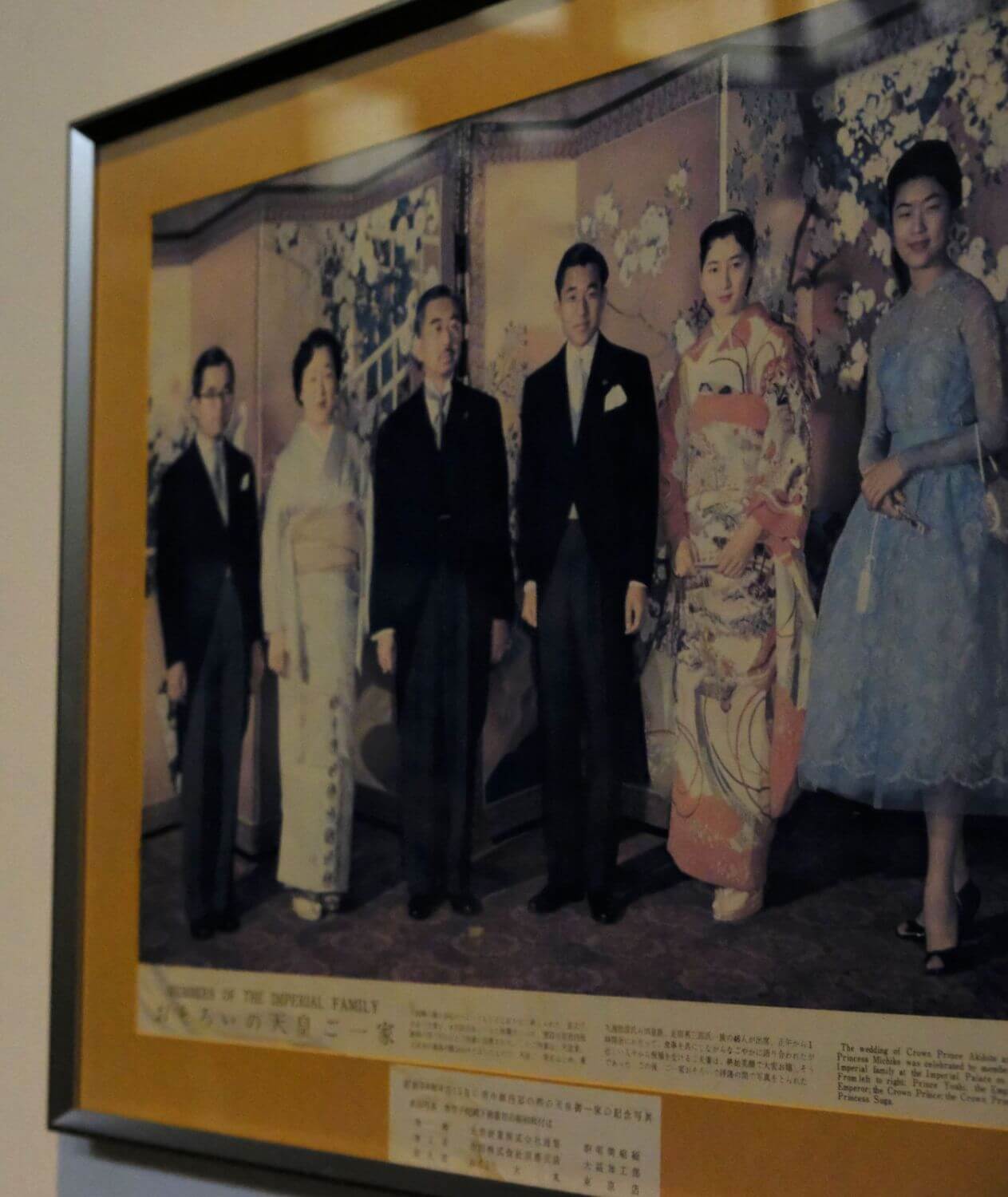
A photo hanging in the Tango Chirimen History Museum of the future emperor Akihito and his new bride, as well as Emperor Showa and Empress Kojun. Michiko Shoda is shown second from the right. (Iwaya, Yosano)
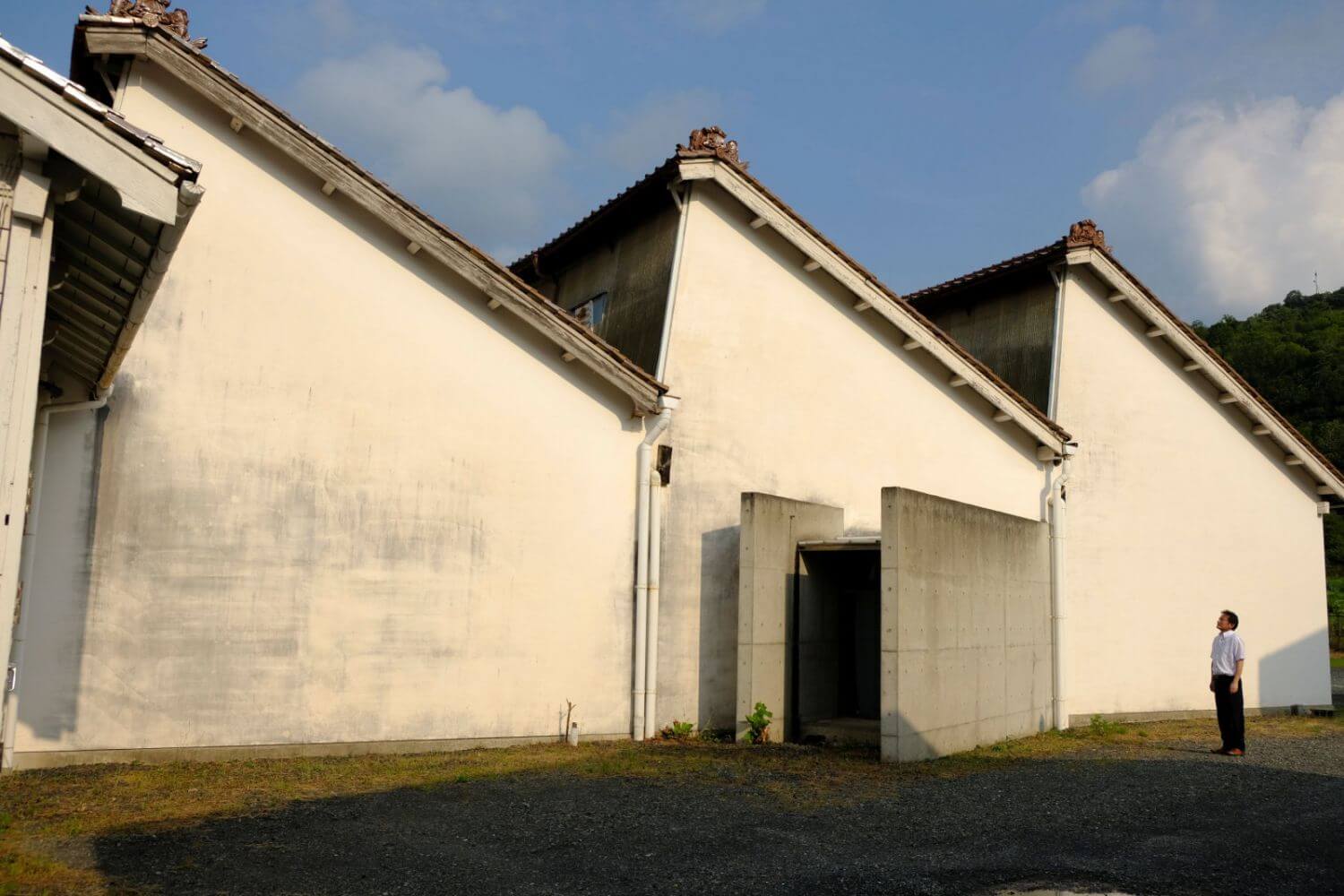
The exterior of the Tango Chirimen History Museum and its sawtoothed roofs, once a part of Daikei Industries. (Iwaya, Yosano)
In April of 1959, the crown prince Akihito was married to Michiko Shoda. Inside of the Tango Chirimen History Museum (Iwaya, Yosano), built inside of a remodeled textitle factory, a picture of the post-wedding reception hangs on the wall. In the photo, the young couple are shown alongside Emperor Showa and Emperess Kojun. The reason for the display, is that the fabric used in the kimono worn by the resplendant Michiko was worked on by a manufacturer once present in the Tango area called “Taikei Industries.”
As the first crown princess to have once been a commoner, Michiko drew a great deal of attention from the populace. Facility director Kousuke Imai (44) says “I have heard of Tango recieving orders for a kimono just the same [as the crown princess]. It was the start of Tango Chirimen’s golden era.
According to the history of the Tango Textile Industrial Association, after the war Japan began exporting luxury goods in order to generate foreign currency and offset imports of food assistance. Even Tango, which had been heavily impacted by donation of looms to the war effort, produced textiles for clothing to be exported to the United States.
Stacks of Bills in their Bellybands
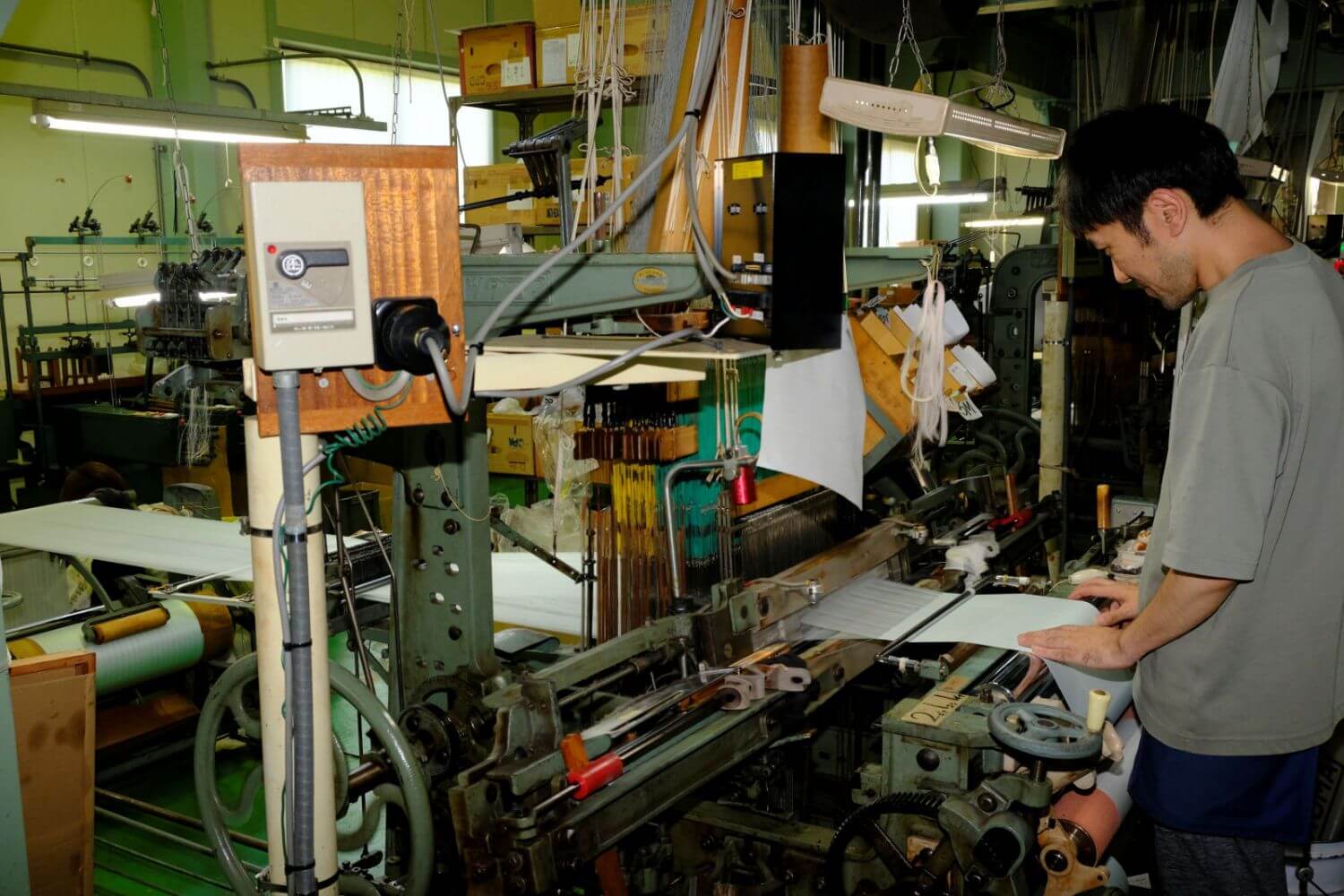
White Tango Chirimen fabric being woven in the Watamasa factory. (Iwaya, Yosano)
In response to the Korean War breaking out in 1950, special procurement demands for textiles and metal gave a boost to economic activity in Tango. As people’s lives began to settle down and Japan entered a period of rapid economic growth, traditional Japanese clothing began to gain attention, and with the Imperial wedding in 1959 demand for silk kimonos is said to have fully recovered.
Masayoshi Watanabe (76), the president of a fabric weaver called Watamasa located near to the history musem, reflected on the golden era and Taikei Industries, saying “women would come from Shimazu Prefecture to work, living in the dorm and studying at the local high school part-time. The area felt lively, and we had hope for the future of production.”
Even as clothing for daily life switched from traditional Japanese to western styles, demand for kimonos increased for use at weddings, coming of age ceremonies, and as formal clothing. According to Masayoshi, factories which couldn’t keep up with the demand would subcontract to other local weavers. In the 70s, when faw thread prices exploded and Tango Chirimen was sold at high prices, “wholesalers without any deals would stuff stacks of bills into their bellybands before going out to buy textiles,” Masayoshi reveals.
Tango Chirimen began to be promoted nationwide. Starting in 1953, the Tango Textile Industrial Association printed posters of famous female actors dressed in kimonos. The first featured Ineko Arima, followed by Ayako Wakao and Sayuri Yoshinaga. The association showed us the kimono worn by Yoko Tsukasa for a poster in 1956, and the floral pattern drew the eyes with its colorful design. From 1971, the posters became calendars, and were made until the Heisei era, featuring actors like Yumi Takigawa and Tomoko Yamaguchi.
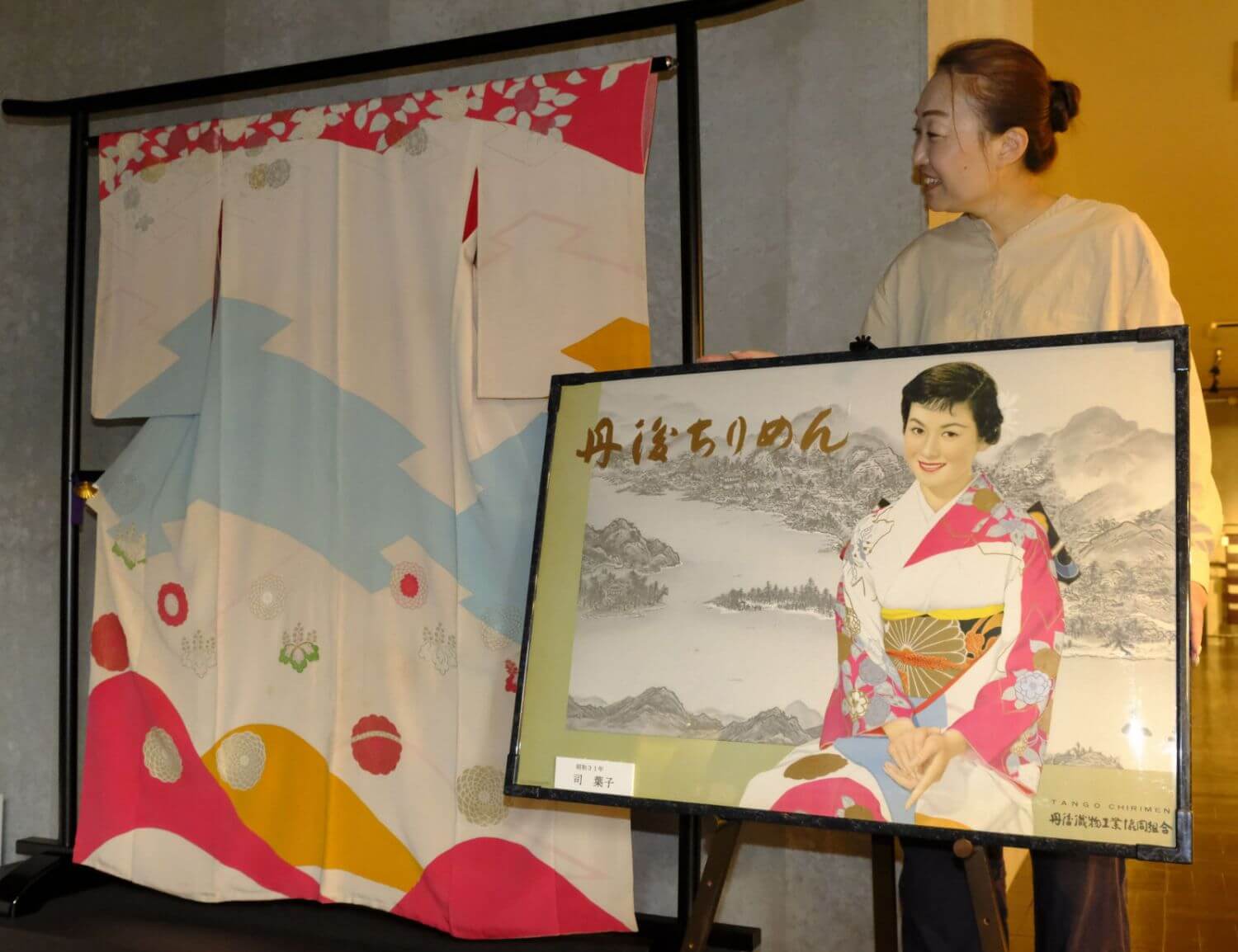
The poster of Yoko Tsukasa shown alongside the kimono worn for the photoshoot. (Tango Textile Industrial Association, Omiya, Kyotango)
Atsushi Yamanaka (79) from Asamogawa, Amino, joined the association in 1970, and worked on promotional activities. He spoke about his experience doing a photoshoot with Yuko Natori, and when they had Hiroshi Itsuki model in order to boost sales of men’s kimonos. “Tango Chirimen was shown more and more on television and in magazines. Across the country, Kimono Shows were held. Tango Chirimen became known as the most luxurious type of silk. People would stuff cabinets full of kimonos to bring as a dowry.”
At the peak of production in 1973, Tango produced enough white fabric for 10 million kimonos (approx. 120 million meteres), reaching as many as 39,000 looms. Stringed together, the silk from that fabric could stretch around the earth three times. Fabric production last year was about 100 times less than it was at the peak. The history of the association describes the atmosphere at the time as one where the looms would make money flow with every gacha gacha sound they made.
Atsushi’s neighbor Kouetsu Yasuyoshi (83) experienced the golden era in the 70s. In Asamogawa, there were over 10 manufacturers weaving spun thread, including Kouetsu.
“They said you could bring a new car to Amino, and it would be guaranteed to sell. People would often go to the new parts of Mineyama which had Geisha performers, or to Gion in Kyoto to spend their money.”
Reverse-Importing from Abroad
However, the good times did not continue for long. In October of 1973, the Arab-Israli war set off an oil shock. Consumers responded to inflation and stopped buying luxury items like traditional clothing.
The next year, in order to protect the local silkworm industry, imports of raw silk were centralized to one authorized importer, and it became tougher for weavers to purchase cheap raw silk. Speaking about the difficulties arising from cheap imported textiles, Kouetsu said “some weavers started working with yarn sellers and wholesalers in low-wage countries like South Korea and China, building factories there and reverse-importing the final product.”
From there, Tango’s silk production would only continue to travel on a downward slope.
Copyright ©The Kyoto Shimbun
Translated by the Kyotango City Tourism Association