2026.11.09|Culture
Weddings and Art, Passing Down Nishijin-ori Weaving
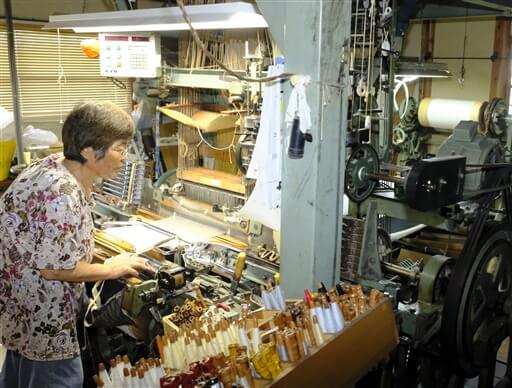
Mariko Ikeda weaving a Nishijin-ori Obi (Honjohama, Ine)
In a fishing village smelling of the sea breeze, the clanking sound of looms weaving Nishijin-ori obi (kimono sashes) echoes through the air. Mariko Ikeda (79), a weaver in Honjōhama, Ine-cho, operates a power loom in her workshop from morning until dusk. A “Debata“, Ms. Ikeda weaves according to instructions from a Nishijin manufacturer, using pre-dyed thread to weave complex colored designs. This technique differs from that used for white Tango chirimen, which is dyed after weaving.
Ms. Ikeda began weaving at the age of 20 in the Kamanyu district, located at the northernmost tip of the Tango Peninsula. Her mother, a native of Yosano Town, was the first to bring looms to a town populated entirely by fisherman. She started a trend, and slowly weaving began to spread across the community.
She moved to Honjōhama after getting married. “It was a fishing village, focused on fixed-net fishing, and there were many women who wove there,” she says. “I’m glad I took up weaving. I could work from home and take care of my children and parents. If I work hard, I can make a living…”
Nishijin-ori is a pre-dyed patterned fabric whose production history dates back to the Heian period. It developed as a high-end silk fabric in the Nishijin district, the name of which translates to “western formation”, after the site of the Western Army’s camp during the Ōnin War (1467–1477), which took place in Kyoto during the Muromachi period (1336–1573).
Echoing Through the Boathouses
The History of Ine-cho describes how Nishijin-ori came to Ine. During the period of rapid economic growth in the late 1950s, agriculture was affected by the staple food control system, while overfishing led to declining catches in the fishing industry. Amid a need for cash income, Nishijin weaving made its way into Yosano-cho and gained a foothold, primarily among housewives of farmers, working at low wages.
In the nearby Ine-cho as well, the industry began in 1960 with just two looms. By its peak in 1975, the number of households engaged in weaving had reached 364, with 685 looms in operation.
Now bustling with tourists, the famous boathouses of Ine-cho once echoed with the sound of looms. According to Yoshiko Shirasu (85) of Kameshima, who wove obi until ten years ago, “there were many people around me who kept looms in their boathouses. Some ran guesthouses on the second floor, and since they’d be weaving from early morning, guests would complain, ‘I can’t sleep!’”
Although affected by the rise and fall of Nishijin-ori, the Tango region remains an important production hub to this day.
According to the Nishijin-ori Industrial Association, shipments exceeded 200 billion yen in the 1980s, but had fallen to only 15 billion yen by 2024. The number of weaving households also dropped from 1,947 in 2008 to 617 in 2023. As of 2023, 73% of Debata hosueholds weaving Nishijin-ori, and 70 percent of major Nishijin-ori obi are woven in Tango.
As the weavers continue to age, efforts to cultivate the next generation of Tango’s Nishijin-ori artisans have begun.
“Kowa” (Kita Ward, Kyoto City), a major manufacturer of Nishijin-ori wedding attire, established its own factory in Iwataki, Yosano-cho, in 2018. At the factory, they use a diverse range of up to 60 colors of raw silk to weave furisode, iro-uchikake, and shiro-muku. Sumire Inari, General Affairs and Accounting Manager, explains, “In Nishijin, the sound of looms is gradually fading away. In Tango, the price of land is lower than in Kyoto City, and as a traditional textile-producing region, is a well-suited environment for securing talent and adjusting looms.”
Their latest creation is a wedding attire collection developed in collaboration with influencer Shinako, a “Harajuku-style video creator,” featuring a vibrant, pop-inspired design with shimmering purple accents.
The company also runs an “Open Factory” to showcase Nishijin-ori techniques. At the Nishijin Asagi Museum in Amino-cho, Kyotango, artisans run 1,800 needle jacquard looms capable of weaving intricate patterns, allowing visitors to observe the weaving process firsthand.
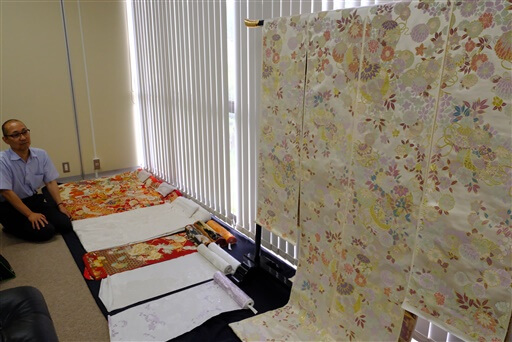
Textiles and wedding attire made by Kowa. Pictured on the right, the iro-uchikake made in collaboration with Shinako (Yosano-cho Iwataki)
Observing His Grandparents
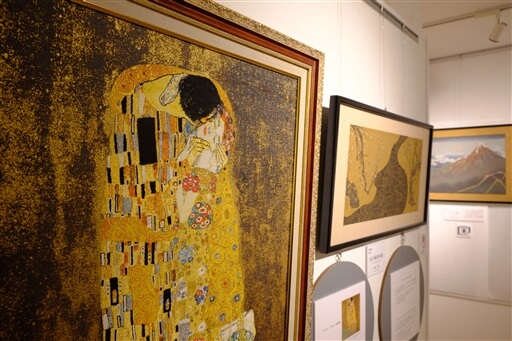
A famous work represented through Nishijin Ori (Tango Creative Center)
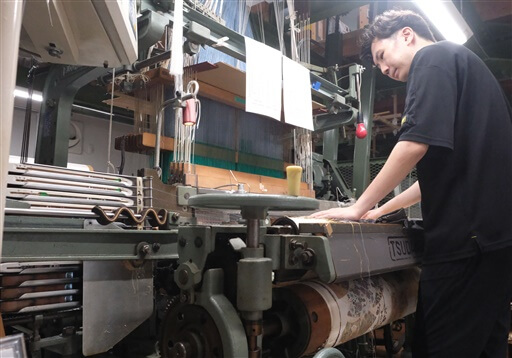
Mr. Okino weaving with an 1,800 needle jacquard loom (Tango Creative Center, Amino-cho, Kyotango)
In the gallery, the facility also displays opulent obi woven with gold and platinum accents, as well as famous paintings, ranging from the Rinpa school and ukiyo-e to Van Gogh and Impressionist paintings, depicted through weaving. A piece depicting Katsushika Hokusai’s “Thirty-Six Views of Mount Fuji: The Great Wave off Kanagawa,” crafted with phosphorescent thread that glows in the dark, is a striking masterpiece.
In 2024 by “Tsukaki Shoji” (Shimogyo Ward, Kyoto City), opened as a wholesaler specializing in kimono. The Debata weavers who have always been the backbone of Tango’s weaving industry are often small operations, working out of homes which double as workshops. It was difficult for them to bring in successors or expand, so Tsukaki Shoji built its own factory. Masaki Kimoto, the center’s manager, says enthusiastically, “This is a place where the weavers, usually in the background, get to take the lead. We want to preserve the traditional techniques of Nishijin-ori.”
Weaver Shuhei Okino (26) aspired to become a craftsman after observing his grandparents work as Debata weavers. “It’s hard work because the fabric is so delicate, but there’s a sense of accomplishment the moment it’s finished,” he says.
Nishijin-ori spread throughout the farming, mountain, and fishing villages of Tango through Debata weavers. Now a Kyoto craft hailed as the pinnacle of textile artistry, it is continuing to be passed down.
Copyright © The Kyoto Shimbun
Translated by Kyotango City Tourism Association